Saturday, December 27, 2014

Here's a great article on setting goals - similar to those teachers set at the team meetings. Enjoy. Courtesy of ASCD SmartBrief.

The Big Fresh Newsletter from Choice Literacy
December 27, 2014 - Issue #413


Happiness of Pursuit
  
When a great adventure is offered, you don't refuse it.
                                                 Amelia Earhart
 
I've been enjoying the book Happiness of Pursuit: Finding the Quest That Will Bring Purpose to Your Life by Chris Guillebeau, about the joy that comes in life from quests. Guillebeau set out to visit every country in the world, and he accomplished his goal while he was still in his mid-30s. He isn't a wealthy guy, and the book chronicles nights spent sleeping on airport floors in third-world countries and the deep anxiety of visiting unsafe countries where westerners weren't welcome. He also shares other stories of ordinary people with extraordinary quests.
The quests can often involve travel. My two sisters are on a quest to bike in each of the 50 states together. Guillebeau writes movingly of a woman with a terminal cancer diagnosis who set out to view more species of birds across the world than anyone had ever seen. But a quest doesn't have to take you far from home -- one of the questers in Guillebeau's book set out to cook an authentic meal from every cuisine in the world, all within the confines of her suburban Colorado home.
The book reminded me that kids aren't only natural-born questioners -- they also love quests. Childhood reading provides a kind of scaffold for the bigger quests children might face down the road. All around us there are children who are right now memorizing dozens of stats for their favorite baseball or hockey team. When I was nine, I fulfilled my quest of reading a whole wall of children's books about the presidents at the town library (just because it was there, I guess).
Maybe we shouldn't be too concerned when a child is on a quest to read every book in a series (even when there are 47 of them), or a book that is far over their reading level because it is a favorite of friends. A quest isn't just an item on a bucket list -- it's something that requires planning, sacrifice, and often a bit of risk.  And aren't those all elements of reading beyond your comfort zone, with goals or texts that are a little bit daunting?
I am not on a quest at the moment, but I want to find one. I'm using the questions Guillebeau provides as a starting point for finding one:
What excites you?
What bothers you?
If you could do anything at all without regard to time or money, what would it be?
I am taking my time finding a quest -- or maybe I'm letting one find me.
This week we look at goals. Plus more as always -- enjoy!
 
Brenda Power
Founder, Choice Literacy


Free for All

 
[For sneak peeks at our upcoming features, quotes and extra links,  follow Choice Literacy on Twitter: @ChoiceLiteracy or Facebook:
 
 
Here are two features from the archives on goals for teachers and students: 
 
Katie Doherty considers goals for book clubs in Assessing Learning During Student-Led Book Clubs:


Ruth Ayres writes about being kind to yourself and realistic in On Perfection and Goals:


Make goals in your classroom SMART (Specific, Measurable, Attainable, Relevant, and Timely) by using this advice from Maurice Elias at Edutopia


Lead Literacy is our subscription site designed especially for literacy coaches and school leaders. You can sample content at this link:
 

Monday, December 8, 2014

Here is a great article on how to use video when supporting teachers in learning and applying new resesarch. Enjoy courtesy of Tch.


Director's Cut — Recorded Webinar: Research-Based Practices for Using Video
Watch the video
Teaching Channel Teams
Using Video for Professional Learning: Research-Based Strategies

Dear Darlene,

We recently held a webinar featuring Miriam Sherin, Professor of Learning Sciences at Northwestern University, and Jamie Lomax, Director of Title I for Tulsa Public Schools.

You can now view a beautifully edited version of the webinar recording on our website. In this version, you won't have to sit through unnecessary explanations of how to use a webinar platform. We take you right into the content you’re interested in seeing.

Click here to watch the video and download the presentation slides.

Jim Knight
Miriam’s presentation details research-based strategies for using video that have been shown to create lasting results in improving teacher practice. Our video-enabled platform, Teaching Channel Teams, provides interactive tools to support these strategies including a mobile app for easily capturing and sharing classroom video.

Michelle Rooks
Jamie’s presentation describes how Tulsa Public Schools is using Teams to put these strategies into action to provide equitable instruction for all students and scale the effectiveness of coaching and PLC programs.

And, while you are visiting our website, check out the other valuable content resources!

Sincerely,
Teaching Channel Teams
MORE RESOURCES AVAILABLE ON OUR WEBSITE
testimonials Hear more stories like Michelle's
Watch videos of educators describing how they are using Teams to bring the power of video to their professional learning programs.
 
Experts Hear from the experts
Watch videos of experts discussing the research on the use of video for professional learning.
 
classroom And learn about:
Effectiveness studies
Structuring the use of video for success
Protocols for effective collaboration around video
Tips and tools
And much more!
Teaching Channel Teams
Professional Development for Common Core State Standards
Watch Teams in Action!

Saturday, November 29, 2014

Here is another great post from Choice Literacy. I highly recommend the Literacy Shed link. It has some great resources. Enjoy!


The Big Fresh Newsletter from Choice Literacy
November 29, 2014 - Issue #410


Cheerfully Indifferent
  
 
Not my circus, not my monkeys.
 
                           Polish proverb
 
This summer I participated in a qigong class, which is sort of a mix of tai chi and martial arts (and that makes the class sound much more strenuous than it was). The group met on a gently sloping lawn at a retreat center in western Massachusetts.  The instructor was in his sixties, calm and funny, with an Irish lilt to his voice. He put us through our paces, all of us beginners looking earnest and silly as we mimicked the moves of a tiger, crane, and dragon. Midway through the class as we all tried to balance on one leg, he said, "The key to focus is to be cheerfully indifferent - to happily ignore most of what bothers you."
I looked out at the view - a stunning vista of a large pristine lake, with mist rising from it in the morning sun. Beyond it was a vast range of mountains, dwarfing the lake. This was in one tiny corner of the world, tucked in the Berkshires. It all made me feel small, in a good way. We have so little time and energy when it comes to all we want to accomplish. We know this, and yet we still think the biggest crime we can commit is to not care enough. But if you try to care about everything, you're just spending your entire life living inside your head. And it's so small compared to all that is out there. The arrogance is in thinking we have more hours or more to give than anyone else.
Ever since that class, I've tried to approach more messes (especially those created by other people) with cheerful indifference. What good does it do to feel your blood pressure rising or your jaw clench at the colleague who is always late to the meeting and needs to be brought up to speed, at the parents who seem to care about their child less than you do? The weight of the world starts to lift when you stay positive and don't invest any energy in things you can't change. A happy countenance is a blessing to anyone who experiences it, and our indifference is a gift to those tasks that need our focus, and the people who can most benefit from our concern. As George Lichtenberg writes, "Nothing can contribute more to peace of soul than the lack of any opinion whatever."
 
This week we consider some strategies for making minilessons more visual. Plus more as always - enjoy!
 
 
Brenda Power
Founder, Choice Literacy


Free for All

 
[For sneak peeks at our upcoming features, quotes and extra links,  follow Choice Literacy on Twitter: @ChoiceLiteracy or Facebook:
 
 
Here are two features from the archives highlighting ways to make minilessons more visual.
 
Clare Landrigan and Tammy Mulligan explain to students how previewing is like watching a movie in Previewing and Picture Walks with Fiction Texts:


Shari Frost and her colleagues have many creative strategies for teaching with wordless picture books in Worth a Thousand Words:


The Literacy Shed is a treasure trove of films and images for use in minilessons:


Last chance to register for the online course Designing Primary Writing Units with the Common Core in Mind instructed by Katie DiCesare, which runs December 3-14. The course includes three on-demand webinars, a DVD, print resources, and personal response from Katie. Click on the link below for more details:


Thursday, November 6, 2014

Here is a great survey for parents to give their children. It measures their readiness for learning. Courtesy of America Achieves.

Do you ever wonder what makes your kids ready to learn?

Developing learning habits like perseverance, hard work, and curiosity helps children achieve more in school - and later in college, work, and life.

So I'm writing to share a resource with you and the parents in your school. Raise the Bar designed this free 5-minute Learning Habits survey to help parents understand their children's strengths and weaknesses so they are better equipped to help them improve.


If you like what you see, we hope you will share our Learning Habits survey and the other resources on our site with parents in your school!  

Enjoy!

Matt and the Raise the Bar Team


The questions in the survey have been developed by Raise the Bar in conjunction with the Character Lab to provide parents with formative feedback on skills that researchers and teachers alike have linked with success.

Monday, October 27, 2014

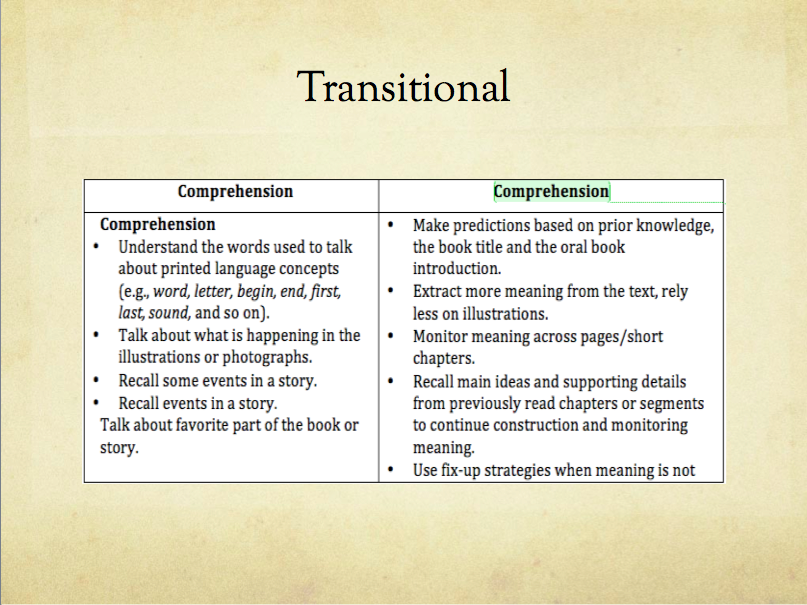
We viewed a lesson from "Guided Reading in Action" by Jan Richardson.  We watched the transitional lesson, at Level M, Henry's Freedom Box . Please post your comments-  I know that we had a lot during our viewing!